
Connect the API
- Lesson 8
- 40 min
- Module 3: Build the prediction service
Lesson 8 of 15 · Deploying AI Models for Real UsersConnect the API
1. Define the inference contract
2. Choose a serving pattern
3. Build the prediction service
4. Choose infrastructure and measure
5. Release, monitor and recover
What you will be able to do
Put the model behind four HTTP routes. They check every ticket against the contract, answer errors in one stable shape, and name the model and threshold in every answer.
Before you startWhat to know and to have ready
What you need to know
- The contract:
TicketIn, missing key against null, unknown categories with a warning, from Prediction inputs and outputs: Write the contract. score_tickets()andjobs.py(JobRunner,QueueFull), from Batch inference and Asynchronous inference.main.pyand the lifespan, from Load and initialize: Write main.py.- The one error shape, from Validation and error responses: Three shapes are two too many in Build and Deploy Your First API. The API key, from Basic protection: The API key in the API course.
What you need on your computer
- The project
~/projects/escalation-servicewithescalation/main.pyandpyproject.toml, from Load and initialize: Write main.py. MODEL_SHA256set in your terminal, as in Load and initialize: Start the service.- If your project is missing or broken, copy the snapshot
end-of-m02and do Load and initialize again. Use a snapshot has the steps.
Tested with Python 3.14.6 and Docker Desktop (Docker Engine 29.6.1) on macOS, Apple silicon. The Windows and Linux steps are not tested.
A receipt with every answer
Section titled “A receipt with every answer”At a pharmacy, you hand in a prescription form. If a field is missing, the pharmacist gives it back and points to the field. If the form is complete, you get the medicine with a printed label: the name, the dose, the date and the pharmacy. Months later, anybody can read the label and know what you got, and from whom.
A prediction API needs the same two things. It rejects a ticket that breaks the contract, and it names the field. And every answer carries its label: which model, which threshold, which request.
The problem: a score without its label
Section titled “The problem: a score without its label”Suppose the API answered only {"score": 0.35}. The help desk must decide: flag the ticket or not? With version 1.0.0, the threshold is 0.19, so 0.35 is flagged. In Module 5, version 1.1.0 uses a threshold of 0.20. Tomás’s candidate 1.1.0-rc1 moves every score up. With the old threshold 0.19, it flags 86% of July’s tickets instead of 20%. The same number means different things for different models.
A bare score has a second problem. When Grace asks in August “why was ticket T-120001 flagged?”, nobody can say which model scored it. And a client that receives three error shapes needs three pieces of code to read them, as you saw in the API course.
The idea: the answer carries its context
Section titled “The idea: the answer carries its context”So the API follows three rules:
- Check before scoring. A ticket that breaks the contract gets
422and the names of the wrong fields. The model never sees it. - One error shape. Every error, from
401to500, has the same body:code,message,request_idandfields. A client readserror.code, never the text. - Every score names its source. The answer has the
score, theflag, thethresholdand themodel_version, pluswarningsfor values the model never saw. The service also writes one log line per score, with the request ID.
The diagram follows one request through these rules:

Text description of the diagram
A request to POST /v1/score gets a request ID first. The API key check comes next: a missing or wrong key ends in 401 unauthorized. Then the contract check: a ticket that does not match ends in 422 invalid_ticket. A ticket that passes goes to score_tickets(), which uses the bundle in memory. It gives the 200 answer with score, flag, threshold, model_version and warnings, and writes one prediction log line. An error during scoring ends in 500 internal_error. The three error answers have one shape: code, message, request_id and fields.
These are the API course’s patterns from the ticket-api, applied to a model. The new parts are the threshold and the model version in each answer, the warnings and the prediction log.
errors.py: one shape for every error
Section titled “errors.py: one shape for every error”Make escalation/errors.py. It has the shape and three handlers, as in the API course:
"""One error shape for every failure, as in the ticket API:{"error": {"code": ..., "message": ..., "request_id": ..., "fields": [...]}}"""
import logging
from fastapi import FastAPI, Requestfrom fastapi.exceptions import RequestValidationErrorfrom fastapi.responses import JSONResponsefrom pydantic import BaseModel, Fieldfrom starlette.exceptions import HTTPException
logger = logging.getLogger("escalation")
CODES = {401: "unauthorized", 404: "not_found", 405: "method_not_allowed", 429: "too_many_jobs"}

class ErrorDetail(BaseModel):    code: str = Field(description="A stable code that a program can check.")    message: str = Field(description="A short explanation for a person.")    request_id: str | None = None    fields: list[str] = []

class ErrorResponse(BaseModel):    error: ErrorDetail

def field_name(error: dict) -> str:    if error["type"] == "json_invalid":        return "body"    return ".".join(str(part) for part in error["loc"][1:]) or "body"

def error_response(request: Request, status: int, code: str, message: str, fields=()) -> JSONResponse:    detail = ErrorDetail(        code=code,        message=message,        request_id=getattr(request.state, "request_id", None),        fields=list(fields),    )    return JSONResponse(status_code=status, content=ErrorResponse(error=detail).model_dump())

def add_error_handlers(app: FastAPI) -> None:    @app.exception_handler(RequestValidationError)    async def invalid_request(request: Request, exc: RequestValidationError):        fields = sorted({field_name(e) for e in exc.errors()})        return error_response(            request, 422, "invalid_ticket", "The ticket does not match the model's contract.", fields        )
    @app.exception_handler(HTTPException)    async def http_error(request: Request, exc: HTTPException):        code = CODES.get(exc.status_code, "http_error")        return error_response(request, exc.status_code, code, str(exc.detail))
    @app.exception_handler(Exception)    async def unexpected(request: Request, exc: Exception):        logger.exception("unexpected error id=%s", getattr(request.state, "request_id", None))        return error_response(request, 500, "internal_error", "Something went wrong on the server.")
invalid_request turns every contract error into 422 invalid_ticket, with the sorted names of the wrong fields. A body that is not JSON at all gives the field body. unexpected logs the full error for you, but sends the client only a short message and the request ID: the inside of the server stays inside.
security.py: the API key
Section titled “security.py: the API key”Make escalation/security.py. It is the API course’s key check:
import secrets
from fastapi import Requestfrom fastapi.security import APIKeyHeaderfrom starlette.exceptions import HTTPException
api_key_header = APIKeyHeader(name="X-API-Key", auto_error=False)

def require_api_key(request: Request) -> None:    """Allow the request only with the right X-API-Key, if a key is set."""    expected = request.app.state.settings.api_key    if expected is None:        return    given = request.headers.get("X-API-Key") or ""    if not secrets.compare_digest(given.encode(), expected.encode()):        raise HTTPException(401, "A valid X-API-Key header is required.")
Without API_KEY, every request passes, which is convenient on your computer. With API_KEY set, a request needs the header X-API-Key with that value. secrets.compare_digest compares in constant time, so the response time does not tell an attacker how many characters were right. Set REQUIRE_API_KEY=true in production: then settings.py refuses to start without a key.
routes.py: four routes
Section titled “routes.py: four routes”Make escalation/routes.py. The first part has the router and the response models:
import jsonimport loggingfrom typing import Annotated
from fastapi import APIRouter, Body, Depends, Request, Responsefrom pydantic import BaseModel, Field
from escalation.contract import TicketInfrom escalation.errors import ErrorResponse, error_responsefrom escalation.jobs import QueueFullfrom escalation.scoring import score_ticketsfrom escalation.security import require_api_key
predictions = logging.getLogger("escalation.predictions")
router = APIRouter(prefix="/v1", dependencies=[Depends(require_api_key)])
ERRORS = {    401: {"model": ErrorResponse, "description": "The API key is missing or wrong."},    422: {"model": ErrorResponse, "description": "The ticket does not match the contract."},}

class ScoreOut(BaseModel):    ticket_id: str    score: float = Field(ge=0, le=1, description="0 to 1. Higher means a higher risk of escalation.")    flag: bool = Field(description="True: send the ticket to the senior team.")    threshold: float = Field(description="The score at and above which a ticket is flagged.")    model_version: str    warnings: list[str] = Field(description="Values the model never saw. The score is less certain.")

class ModelInfo(BaseModel):    model_version: str    bundle_sha256: str    threshold: float    trained_at: str    features: list[str]

class JobIn(BaseModel):    tickets: list[TicketIn] = Field(min_length=1)

class JobStatus(BaseModel):    job_id: str    status: str = Field(description="queued, running, done or failed")    tickets: int    created_at: str    finished_at: str | None = None    seconds: float | None = None    model_version: str | None = None    results: list[dict] | None = None    error: str | None = None
dependencies=[Depends(require_api_key)] puts the key check on every route under /v1. /health and /ready are in main.py, outside the router, so a platform can call them without a key. ScoreOut is the label from the pharmacy: each field has a description, which becomes the API documentation.
The second part is the two model routes:
@router.post("/score", tags=["scoring"], summary="Score one new ticket", responses=ERRORS)def score(ticket: TicketIn, request: Request, response: Response) -> ScoreOut:    state = request.app.state    [result], timings = score_tickets(state.bundle, [ticket])    response.headers["Server-Timing"] = timings.header()    record = {        "request_id": request.state.request_id,        "ticket_id": ticket.ticket_id,        "model_version": state.bundle.version,        "score": result.score,        "flag": result.flag,    }    predictions.info(json.dumps(record))    return ScoreOut(        ticket_id=ticket.ticket_id,        score=result.score,        flag=result.flag,        threshold=state.bundle.threshold,        model_version=state.bundle.version,        warnings=result.warnings,    )

@router.get("/model", tags=["model"], summary="Which model answers, and how to check it")def model(request: Request) -> ModelInfo:    bundle = request.app.state.bundle    return ModelInfo(        model_version=bundle.version,        bundle_sha256=bundle.digest,        threshold=bundle.threshold,        trained_at=bundle.metadata["trained_at"],        features=bundle.contract["features"],    )
The parameter ticket: TicketIn does the contract check: FastAPI validates the body with the class from Module 1 before the function runs. The route then calls the same score_tickets() as the batch job. So the API and the batch job always score a ticket in the same way. The Server-Timing header carries the three timed steps, for Module 4’s measurements.
The route writes one log line per score, as JSON, to the logger escalation.predictions. Why? A score is a prediction about the next 72 hours. Only later does Larkfield know if the ticket was escalated. In Module 5, Monitor model health joins these lines with the real outcomes by ticket_id, to measure precision and recall on live tickets. Without the log, the evidence is gone. The line holds no customer data: only IDs, the version and the result.
The third part wires the job runner of Module 2 to two routes:
def status_of(job) -> JobStatus:    return JobStatus(        job_id=job.id,        status=job.status,        tickets=len(job.results) if job.results is not None else len(job.tickets),        created_at=job.created_at,        finished_at=job.finished_at,        seconds=job.seconds,        model_version=job.model_version,        results=job.results if job.status == "done" else None,        error=job.error,    )

@router.post(    "/jobs",    tags=["jobs"],    status_code=202,    summary="Score many tickets later",    responses={**ERRORS, 429: {"model": ErrorResponse, "description": "Too many jobs are waiting."}},)def submit_job(job_in: Annotated[JobIn, Body()], request: Request, response: Response) -> JobStatus:    limit = request.app.state.settings.max_job_tickets    if len(job_in.tickets) > limit:        return error_response(request, 413, "job_too_large", f"A job can have at most {limit} tickets.")    try:        job = request.app.state.jobs.submit(job_in.tickets)    except QueueFull:        return error_response(request, 429, "too_many_jobs", "Too many jobs are waiting. Try again later.")    response.headers["Location"] = f"/v1/jobs/{job.id}"    response.headers["Retry-After"] = "2"    return status_of(job)

@router.get("/jobs/{job_id}", tags=["jobs"], summary="The status of a job, and its scores when done")def get_job(job_id: str, request: Request) -> JobStatus:    job = request.app.state.jobs.jobs.get(job_id)    if job is None:        return error_response(request, 404, "job_not_found", "There is no job with this ID here.")    return status_of(job)
Each ticket in a job passes the same contract check, because JobIn holds a list of TicketIn. The rest is Module 2’s design: 202 Accepted, the Location of the status, Retry-After, and 429 when four jobs already wait.
Worked example: call each route
Section titled “Worked example: call each route”Start the service as in Load and initialize, without API_KEY. In a second terminal, score the example ticket from contract.py. The option -i shows the headers too:
curl -i http://127.0.0.1:8000/v1/score -H "Content-Type: application/json" -d '{"ticket_id":"T-120001","channel":"email","team":"payment","segment":"home","region":"west","priority":1,"order_value":89.5,"word_count":112,"customer_tenure_days":400,"prior_tickets_90d":2,"created_hour":10,"prior_escalations_90d":1}'$ticket = '{"ticket_id":"T-120001","channel":"email","team":"payment","segment":"home","region":"west","priority":1,"order_value":89.5,"word_count":112,"customer_tenure_days":400,"prior_tickets_90d":2,"created_hour":10,"prior_escalations_90d":1}'Invoke-WebRequest -Method Post -Uri http://127.0.0.1:8000/v1/score -ContentType "application/json" -Body $ticketThe output:
HTTP/1.1 200 OKdate: Thu, 08 Oct 2026 14:35:05 GMTserver: uvicorncontent-length: 119content-type: application/jsonserver-timing: frame;dur=1.07, prepare;dur=1.81, model;dur=0.07x-request-id: 53ffd3d9d351
{"ticket_id":"T-120001","score":0.35065699401024064,"flag":true,"threshold":0.19,"model_version":"1.0.0","warnings":[]}
The score 0.351 is above the threshold 0.19, so flag is true. In the service’s terminal, the prediction log line has the same request ID:
INFO escalation.predictions: {"request_id": "53ffd3d9d351", "ticket_id": "T-120001", "model_version": "1.0.0", "score": 0.35065699401024064, "flag": true}INFO escalation: POST /v1/score 200 4.9ms id=53ffd3d9d351Now break the contract twice in one ticket: priority "high" and created_hour 24. Change those two values in the command and send it again. The output:
HTTP/1.1 422 Unprocessable Content...x-request-id: e53bd384c649
{"error":{"code":"invalid_ticket","message":"The ticket does not match the model's contract.","request_id":"e53bd384c649","fields":["created_hour","priority"]}}
Both wrong fields are named, and the model never ran. Next, two cases from Module 1. Remove the key "order_value":89.5, completely. Then put it back as "order_value":null and set "channel":"social". The two outputs:
{"error":{"code":"invalid_ticket","message":"The ticket does not match the model's contract.","request_id":"179de6f59408","fields":["order_value"]}}{"ticket_id":"T-120001","score":0.4310802648610386,"flag":true,"threshold":0.19,"model_version":"1.0.0","warnings":["channel: 'social' is a value the model never saw"]}A missing key is an error; a null value is a known missing value, and the pipeline’s imputer fills it. The new channel is scored, with a warning in the answer.
Ask the service which model answers:
curl http://127.0.0.1:8000/v1/modelThe output:
{"model_version":"1.0.0","bundle_sha256":"8f233029aa4c896dce1a5b3dfa970cd085088386bbe7784519f15a5b1a433b74","threshold":0.19,"trained_at":"2026-10-08 13:53:54 UTC","features":["channel","team","segment","region","priority","order_value","word_count","customer_tenure_days","prior_tickets_90d","created_hour","prior_escalations_90d"]}bundle_sha256 is the full digest, so anybody can compare it with the release record. Your digest and trained_at are your own.
Last, a job with the same ticket three times. Send {"tickets":[…]} with the ticket three times to /v1/jobs, then call the URL in Location. The outputs (headers shortened):
HTTP/1.1 202 Acceptedlocation: /v1/jobs/b28f86e15848retry-after: 2...{"job_id":"b28f86e15848","status":"queued","tickets":3,"created_at":"2026-10-08T14:35:05+00:00","finished_at":null,"seconds":null,"model_version":null,"results":null,"error":null}{"job_id":"b28f86e15848","status":"done","tickets":3,"created_at":"2026-10-08T14:35:05+00:00","finished_at":"2026-10-08T14:35:05+00:00","seconds":0.003,"model_version":"1.0.0","results":[{"ticket_id":"T-120001","score":0.35065699401024064,"flag":true},...],"error":null}The job’s scores equal the online score, 0.35065699401024064, because both paths call score_tickets() with the same bundle.
The API key
Section titled “The API key”Stop the service. Start it again with a key, then send the example ticket without and with the header:
API_KEY=change-me-1234 fastapi runcurl -i http://127.0.0.1:8000/v1/score -H "Content-Type: application/json" -d '…the example ticket…'curl http://127.0.0.1:8000/v1/score -H "Content-Type: application/json" -H "X-API-Key: change-me-1234" -d '…the example ticket…'On Windows, set $env:API_KEY = "change-me-1234" before fastapi run, and add -Headers @{"X-API-Key"="change-me-1234"} to Invoke-WebRequest. The output (headers shortened):
HTTP/1.1 401 Unauthorized...{"error":{"code":"unauthorized","message":"A valid X-API-Key header is required.","request_id":"68782a77b2f0","fields":[]}}{"ticket_id":"T-120001","score":0.35065699401024064,"flag":true,"threshold":0.19,"model_version":"1.0.0","warnings":[]}/health still answers {"status":"ok"} without a key. In the Docker course, the key came from a secret file with API_KEY_FILE, and settings.py reads that too. Stop the service, and start it again without API_KEY for the next part.
Swagger UI
Section titled “Swagger UI”FastAPI documents the routes for you at /docs. Open http://127.0.0.1:8000/docs:
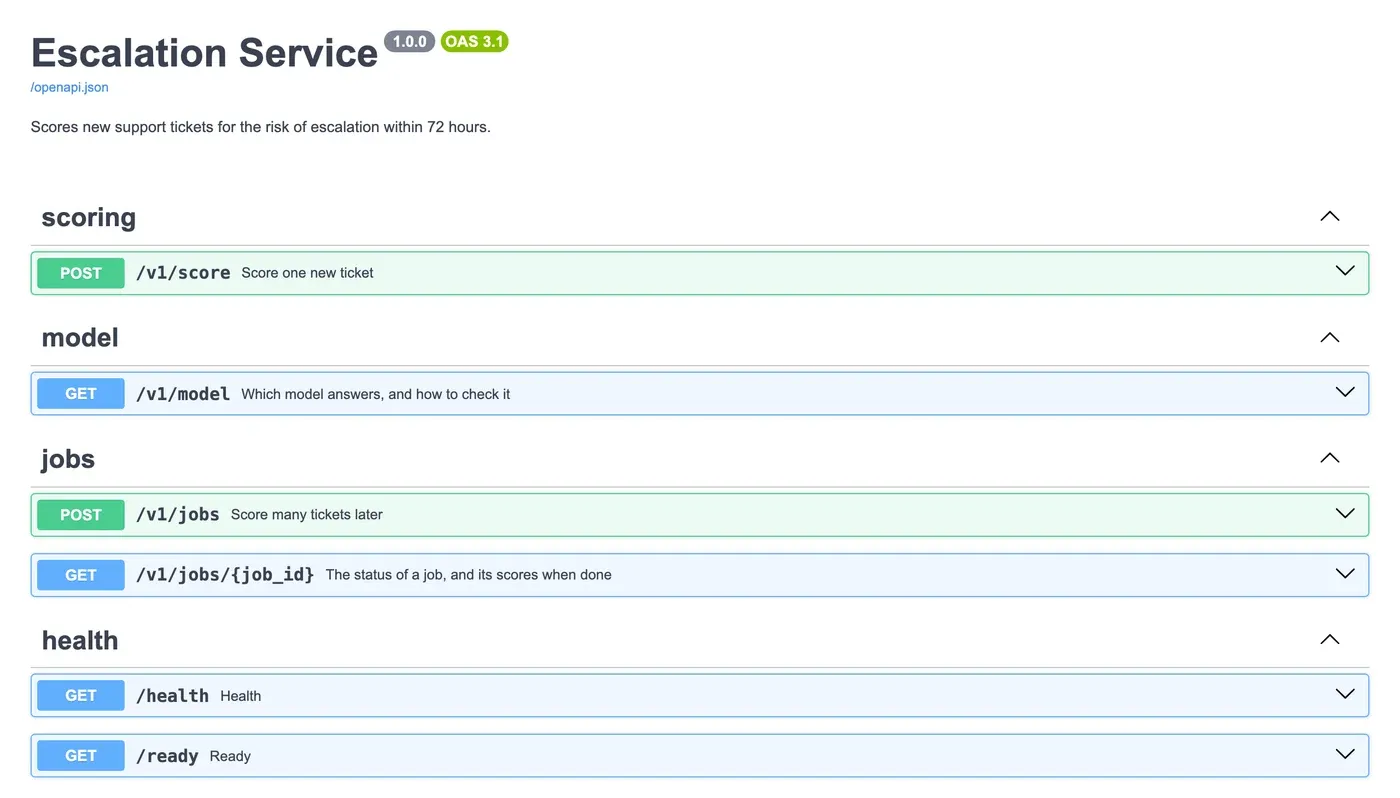
Select POST /v1/score to see the example ticket from contract.py, the ScoreOut fields with their descriptions, and the 401 and 422 answers with ErrorResponse. Select Try it out and Execute to score the example. This page has no Authorize button: require_api_key reads the header itself, so the OpenAPI document does not describe the key. Use curl when a key is set. In production, SHOW_DOCS=false turns the page off.
Tests for the API
Section titled “Tests for the API”The API tests need a client: a test client that sends requests to the app in memory, with no server and no port. Add it to tests/conftest.py. First the import, after import pytest:
from fastapi.testclient import TestClientThen the fixture, after the other fixtures at the end of the file:
@pytest.fixturedef client():    from escalation.main import create_app
    with TestClient(create_app()) as test_client:        yield test_client
create_app is imported inside the fixture, so it runs after the fixture settings_env (from Batch inference) has set MODEL_SHA256 for the test bundle. The with block runs the lifespan, so each test gets the real bundle, loaded and checked as in the server.
Now make tests/test_api.py. Each test proves one rule of this lesson, with the client and ticket fixtures:
import time

def test_score_one_ticket(client, ticket):    response = client.post("/v1/score", json=ticket)    assert response.status_code == 200    body = response.json()    assert body["model_version"] == "1.0.0"    assert 0 <= body["score"] <= 1    assert body["flag"] == (body["score"] >= body["threshold"])    assert "model;dur=" in response.headers["Server-Timing"]

def test_a_contract_error_has_the_error_shape(client, ticket):    response = client.post("/v1/score", json={**ticket, "priority": "high", "created_hour": 24})    assert response.status_code == 422    error = response.json()["error"]    assert error["code"] == "invalid_ticket"    assert error["fields"] == ["created_hour", "priority"]

def test_an_unknown_category_is_scored_with_a_warning(client, ticket):    body = client.post("/v1/score", json={**ticket, "channel": "social"}).json()    assert body["warnings"] == ["channel: 'social' is a value the model never saw"]

def test_the_model_endpoint_names_the_bundle(client):    body = client.get("/v1/model").json()    assert body["model_version"] == "1.0.0"    assert len(body["bundle_sha256"]) == 64

def test_ready_names_the_model(client):    assert client.get("/ready").json() == {"status": "ready", "model_version": "1.0.0"}

def test_a_job_is_accepted_then_done(client, ticket):    response = client.post("/v1/jobs", json={"tickets": [ticket] * 3})    assert response.status_code == 202    location = response.headers["Location"]    for _ in range(50):        body = client.get(location).json()        if body["status"] == "done":            break        time.sleep(0.02)    assert body["status"] == "done"    assert len(body["results"]) == 3

def test_an_unknown_job_is_404(client):    assert client.get("/v1/jobs/nothere").json()["error"]["code"] == "job_not_found"

def test_a_key_is_required_when_set(monkeypatch, ticket):    from fastapi.testclient import TestClient
    from escalation.main import create_app
    monkeypatch.setenv("API_KEY", "test-key")    with TestClient(create_app()) as client:        assert client.post("/v1/score", json=ticket).status_code == 401        assert client.post("/v1/score", json=ticket, headers={"X-API-Key": "test-key"}).status_code == 200
Run them:
python -m pytest tests/test_api.py -vThe output (shortened):
tests/test_api.py::test_score_one_ticket PASSED                          [ 12%]tests/test_api.py::test_a_contract_error_has_the_error_shape PASSED      [ 25%]...tests/test_api.py::test_a_key_is_required_when_set PASSED                [100%]
============================== 8 passed in 0.95s ===============================
python -m pytest runs the whole suite: 28 passed.
Guided practice: wrap the classifier in the API
Section titled “Guided practice: wrap the classifier in the API”This is the outline’s practice for the module: put the classifier behind the API with the same patterns as the API course’s ticket-api.
- Write
escalation/errors.py,escalation/security.pyandescalation/routes.pyas above. If you copied them from the snapshot in the last lesson, compare them with this page. - Add the
clientfixture totests/conftest.py, and writetests/test_api.py. - Run
python -m pytest. The last line says28 passed. - Start the service with
fastapi run. - Score the example ticket with
curl -i. Check the four fieldsscore,flag,thresholdandmodel_version, and the headerx-request-id. - Find the prediction log line with the same request ID in the service’s terminal.
- Call
/v1/model. Check thatbundle_sha256starts with the 12 characters of the start-up log line.
Show the expected result of steps 5 and 6
A 200 answer with "score":0.35065699401024064,"flag":true,"threshold":0.19,"model_version":"1.0.0","warnings":[], and a log line INFO escalation.predictions: {"request_id": "…", "ticket_id": "T-120001", …} with the same ID as the x-request-id header. The ID itself is random.
Your turn: an extra field
Section titled “Your turn: an extra field”The contract has extra="forbid". Send the example ticket with one more field, "colour":"red". Predict first: status code, code and fields?
Show the answer
{"error":{"code":"invalid_ticket","message":"The ticket does not match the model's contract.","request_id":"5c935dcc4129","fields":["colour"]}}The status is 422. An extra field is rejected and named, because a client that sends colour may believe that the model uses it. The model does not, so the API says so at once.
Common mistake
Every request gets 422 with the field body
Symptom: a script on Windows sends tickets, and every answer is:
{"error":{"code":"invalid_ticket","message":"The ticket does not match the model's contract.","request_id":"c2c4f45d10bf","fields":["body"]}}The service’s log shows POST /v1/score 422 for each request, and no prediction line.
Cause: the body is not valid JSON, so the contract check never reads a single field. Here, the shell changed the quotes: the body arrived as {'ticket_id':'T-120001'}, with single quotes, which JSON does not allow. field_name() reports a JSON error as the field body.
Fix: send the body exactly as JSON. In PowerShell, keep the JSON in a variable with single quotes outside and double quotes inside, as in the worked example, or let ConvertTo-Json make it. Check one request with -i before you send many.
For a real AI service: a 422 is cheap and safe: no model ran, and the client learns what to fix. Count 422 answers by fields. A sudden rise of body errors means a broken client; a rise of one field means that a client changed what it sends. Module 5 counts these signals.
Check your understanding
Why does every answer of POST /v1/score include the threshold and the model version, not only the score?
Show the answer
A score means nothing without the model and threshold that go with it. Version 1.0.0 flags at 0.19 and version 1.1.0 at 0.20. The faulty candidate rc1 moves all scores up, so 0.19 flags 86% of tickets. With the version and threshold in the answer and the log, a client decides correctly. Later, anybody can say which model scored a ticket.
Does your answer have the main points of ours?
Sign in and enroll in the course to save your answers. Every check counts toward the certificate.
Check your understanding
The service writes one JSON log line per score with the request ID, ticket ID, model version, score and flag. Why, and what must it not contain?
Show the answer
The real outcome (escalated or not) arrives days later. The log lines let the team join each prediction with its outcome by ticket ID. Then they can measure precision and recall on live tickets, per model version (Module 5). The request ID links the line to the client’s answer. The line must not contain customer data, such as the text of the ticket or a name: only IDs and the result.
Does your answer have the main points of ours?
Sign in and enroll in the course to save your answers. Every check counts toward the certificate.
Check your understanding
A client sends a ticket without the key order_value, and another sends order_value: null. What does each get, and why the difference?
Show the answer
Without the key: 422 invalid_ticket with fields: ["order_value"], because the contract requires the key. With null: 200 and a score. Null is the agreed way to say “there is no order”, and the pipeline’s imputer fills it as in training. A missing key is more likely a broken client than a real missing value.
Does your answer have the main points of ours?
Sign in and enroll in the course to save your answers. Every check counts toward the certificate.
Recap
POST /v1/scorechecks the ticket with the contract before the model runs, and answers withscore,flag,threshold,model_versionandwarnings.GET /v1/modelnames the version, the full digest, the threshold and the features. The job routes wire Module 2’sJobRunner.- Every error has one shape:
code,message,request_id,fields. Every response hasX-Request-ID. - One JSON log line per score keeps the evidence for monitoring when the outcomes arrive.
- The API key protects
/v1;/healthand/readystay open for the platform. tests/test_api.pyproves each rule:28 passed.
Next, you prove that the served scores are the scores that training gave: parity.
Next: Check parity